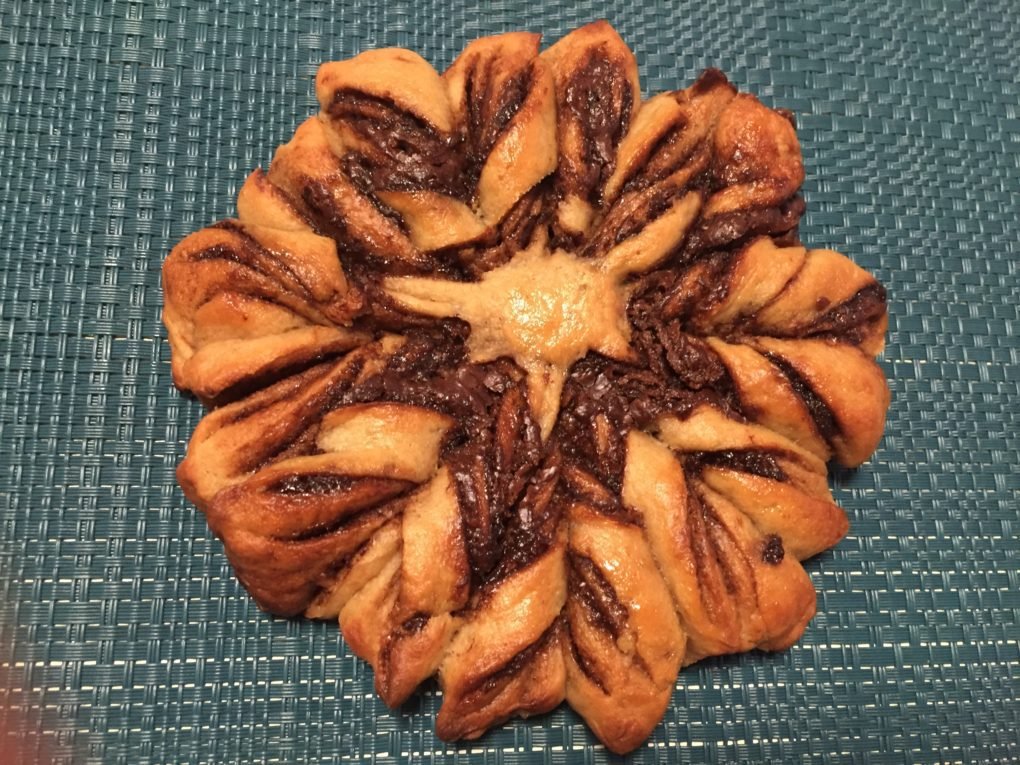
Nutella Flower Whole Wheat Bread
Dear friends,
Once you know to knead the dough for making bread, you can further experiment to make different kinds of breads. Here’s a step by step process of kneading bread flour and baking it to make Whole Wheat Bread.
I have mentioned in that recipe that I will show you the step by step process of making whole wheat nutella flower bread, so here we go! The other day I had only used half of my dough in making the bread loaf . The other half I had used for making whole wheat nutella flower bread and whole wheat braided bread.
You can use the entire measured flour for making a whole big nutella flower bread or can divide it into two, three or four parts making small size nutella flower bread with the other parts. The quantity of nutella used for making the flower bread will vary as per the size you make.
For making the flower bread, the procedure for making the bread dough remains the same till the second proving or second rise of the bread. After that please go through the step by step process I have shared below.
When this nutella filled bread is baking in the house, the aroma it releases is too tempting and you just can’t wait to have one as soon as it is baked.
This nutella flower bread looks elegant and is the perfect dish to be taken for a potluck or can be had during the high tea parties or kitty parties along with a hot cup of tea or coffee.
Nutella Flower Whole Wheat Bread
Ingredients
- 4 cup whole wheat flour Use 3.5 cups for kneading and 0.5 cups for dusting and further addition of dough if required for kneading.
- 2 tbsp milk powder
- 1 tsp salt
- 4 tsp instant dry yeast (two sachet of 7 gm)
- 1 tbsp sugar
- 1 cup water (luke warm)
- 3/4 cup milk luke warm
- 4 tbsp oil and little more for greasing dough
- 1 tbsp butter brushing the flower bread
- 1 tbsp extra milk brushing the flower bread
- 4 tbsp nutella
Instructions
- After the second proving as mentioned in the recipe for whole wheat flour, take the flour and roll it in the shape of a log as shown and cut it into four equal parts.

- Now make them into balls and flatten them.

- Take a butter paper and place one flatten ball over it.

- Place other butter paper on it and roll it into a circle.

- Now with a help of a round cutter or plate or a container as shown mark a circle on it as shown.


- With a butter knife apply nutella over it. If nutella is thick then warm it in microwave for 30 seconds and then apply.

- Now Keep it aside and with the other flattened ball roll another circle. Place that over the nutella applied circle and mark a circle with the cutter as shown. Apply nutella over it. This becomes the second layer.

- Similarly make the third layer and apply nutella over it.

- Now for the last layer take the last left flatten ball and roll a circle and place over the nutella applied layer. With the help of the sharp cutter cut the into circle and remove the excess layer .

- In the center of the circle, place a round cutter or glass or a bottle lid as shown.

- Cut the cirlce first into four parts, then cut each parts into half and then again into half resulting a total of sixteen parts as shown.

- Grab two parts, one in each of your hands and twist them in opposite directions gently as shown.

- This will end up in making this kind of flower.

- Join the petal edges with each other in the end as shown. Keep it covered for the second proving for 45 minutes. Brush it with milk .

- Bake it in preheated oven at 200 deg celcius for 20 -25 minutes or till golden. Whole wheat nutella flower is ready to serve. Brush it with butter to get a nice taste and glaze. Serve it warm.

Nutrition
Beet Root Paratha (Beet Root Flat Bread)
Beetroot is a type of root. Due to its sweet taste, it can be eaten raw. The leaves of the beetroot are also edible and can be eaten boiled or steamed. Beetroot has a rich purple colour but they are also grown white or golden.
Beetroots are an excellent source of folic acid and a very good source of fibre, manganese and potassium.
Beetroot is used for disorders of the liver as they help to stimulate the liver’s detoxification processes. They help in maintaining the blood count in the body. They are good for haemoglobin. As beetroot is rich in fibre, it helps in preventing constipation. It also helps in lowering cholesterol levels. Beetroot juice is considered good for maintaining blood pressure levels in the body.
So try to use beetroot as much as possible. Beet roots can be used in salads, soups, cakes, desserts or raitas.
I will share with you the recipe of beetroot paratha which is easy to make. I have used garlic here but they can be made without garlic. So they can be relished by people who do not eat garlic too.They can be enjoyed with curry, raita, chutneys or sauce. They can be had for breakfast, lunch or dinner. They taste good both hot and cold and have a nice pleasing colour. They are the best way to encourage kids to eat beetroot.
Beet Root Paratha (Beet Root Flat Bread)
Ingredients
- 1 medium beetroot boiled and grated
- 1 cup whole wheat flour
- 4 tbsp oil
- 1/2 tbsp ginger paste
- 1/2 tbsp garlic paste (you can avoid garlic if you are not eating)
- 1 green chili finely chopped (optional)
- 1 tsp cumin powder
- 1 tsp black pepper powder
- 1/2 tsp garam masala powder
- 1 tsp coriander powder
- 1 tsp red chili powder
- 2 tbsp coriander chopped
- 1 tbsp sesame seeds
- oil for roasting the parathas
- salt as per taste
- water for kneading
- extra wheat flour for dusting while rolling paratha
Instructions
- In a bowl take grated beet root and add chopped coriander to it.

- Add wheat flour, oil, ginger-garlic paste, chopped green chili, coriander powder, cumin powder, red chili powder, black pepper powder, sesame seeds, garam masala and salt. Mix it well with the fingertips till you get crumb like texture as shown.

- Add small quantities of water and knead a smooth stiff dough for paratha. Let it rest for 15 min.

- Take a ball and flatten it as shown.

- Dust the flattened ball with flour on both the sides and roll into a cirlce of 2mm thickness.

- Put it on a heated flat pan or tava. Roast it on one side.

- Flip it on the other side and then a tsp of oil on it. Roast it now on both the sides till golden spots appear on it. The parathas are done.

- Repeat the procedure to make other parathas. Serve them with curry, chutney, sauce, curd or raita.

Nutrition
Kaju Karela Nu Shak / Kaju Karele Ki Subji (Bitter Gourd And Cashewnut Stir Fry)
Bittergourd is used widely for its medicinal values. Bittergourd and the parts of its plants are useful as traditional medicines for curing of diabetes, stomach complaints, skin diseases, ulcers or cough.
Various types of dishes are made from bitter gourd. Not only in India but it is widely used in Asian cuisine.
In India, the bittergourd preparation varies with region. In North Indian cuisine- they make by stuffing it with spices in the form of curry also known as Bharwa Karele (Stuffed karela). In South Indian cuisine, it is used in the dishes thoran/thuvaran (mixed with grated coconut), mezhukkuparatti (stir fried with spices), theeyal (cooked with roasted coconut) and pachadi.
Many people add salt to the sliced bittergourd and keep it for some time. They then squeeze out the excess of water. This helps in reducing the bitterness. Some people also peel off the skin and use only the flesh of bittergourd.
The bittergourd grows on a vine. It is best to eat it when it is tender. The skin, flesh and the seeds are less bitter at this stage. But as it ripens, the flesh and seeds tend to become harder and more bitter.
I try to use the tender bittergourd as they are easy to chop, cook and then can be used directly with the skin.
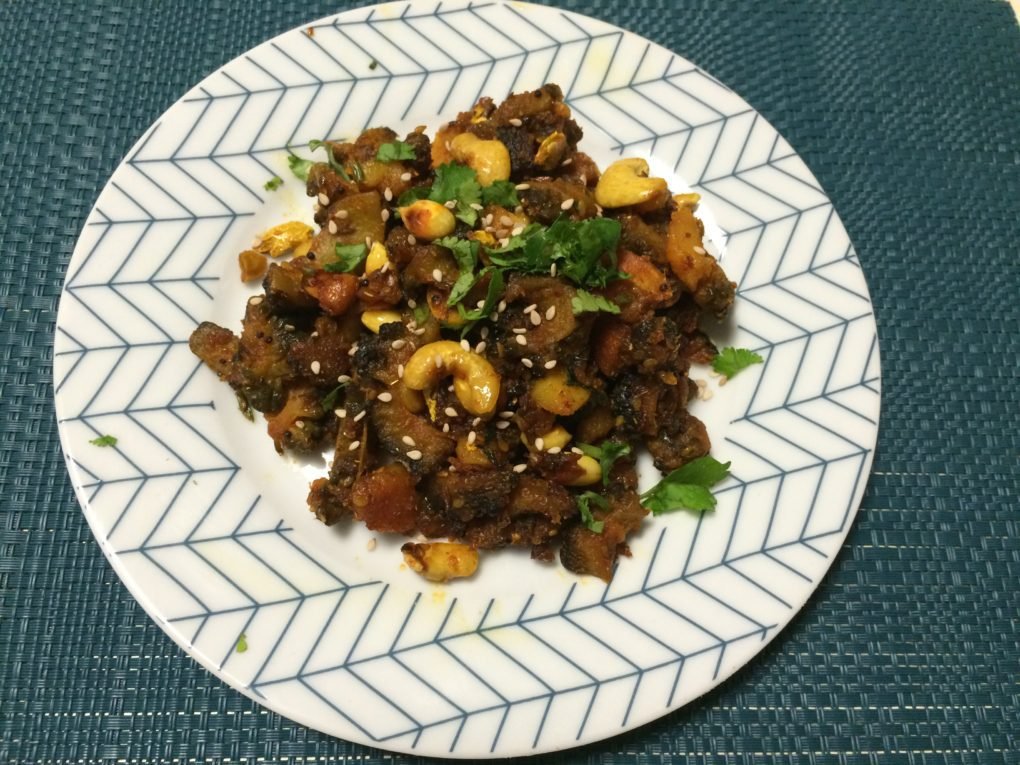
I will share with you popular Gujarati cuisine preparation of bittergourd. It is made from tender bittergourd and stir fried with the spices, jaggery, cashew nuts, peanuts and sesame seeds. The cashew nuts and peanuts give a crunchy effect to the dish. You can mostly find this dish on the menu during marriage functions. It is served with puri or chapati and aamras. There they generally deep fry the bittergourd .
I have made it without frying. I make it regularly in my house. The jaggery helps in reducing bitterness and when it melts, the bittergourd and potatoes are nicely coated with it. This gives a nice sweet taste. Howeer, the taste balanced with other different spices used.
Serve it with puri or chapati. It also goes well Gujaratiarati dal and rice.
Kaju Karela (Bitter Gourd And Cashewnut Stir Fry)
Ingredients
- 250 gm bitter gourd cleaned, washes and chopped in semicircles.(you can discard seeds if they are to hard)
- 1 medium potato chopped lengthwise
- 4 tbsp jaggery grated
- 4 tbsp oil
- 2 tbsp cashew nut halved
- 2 tbsp peanuts roasted and halved
- 2 tbsp sesame seeds. Use 2 tsp for garnishing
- 2 tbsp raisin
- 1 tsp mustard seeds
- 1 tsp cumin seeds
- 1/4 tsp asafoetida
- 1 tsp turmeric powder
- 2 tsp red chili powder
- 1 tbsp coriander powder
- 1 tsp cumin powder
- 1/4 cup coriander chopped. leave a little for garnishing.
- salt as per taste
Instructions
- Chop the bittergourd and potato as shown. I have also used the seed which are tender as I like the crunchy texture it gives to the dish. I have used the bittergourd with the skin (why should we remove the goodness from it!)

- Heat oil in the pan. Add the mustard seed and cumin seeds. When they crackle add the asafoetida, sesame seeds and turmeric powder.

- Add the chopped bittergourd and potatoes. Add salt. Mix well and cover and cook them till tender on medium heat.

- Once they are cooked, remove the lid and add red chili powder, coriander cumin seed powder and mix well.

- Add the jaggery and let it melt.

- Add the cashewnuts, roasted peanuts and raisin and saute them till the jaggery is nicely coated with the bitter gourd and potato. Add the chopped coriander and mix well. The Kaju karela is ready.

- Garnish with chopped coriander and sesame seed and serve it with roti, puri and gujarati dal and rice.

Nutrition
Whole Wheat Bread
Whole wheat bread can be made using 100% wheat flour or with the combination of whole wheat flour and refined flour. in this recipe I have made it using 100% wheat flour.
The bread came out nice and soft.
Breads can be made with fresh yeast, active dry yeast or instant dry yeast. So the proportions for different types of yeast to the yeast mentioned in the recipe goes this way – If the recipe says 1 tsp of instant dry yeast and if you have active dry yeast, then use 1/2 tbsp of it. If you want to use fresh yeast then you are required to use double of the active dry yeast, that is 1 tbsp of it.
Fresh yeast and the instant dry yeast can be added directly to the flour while kneading with the other ingredient. Dry active yeast needs to be activated by adding it in warm milk or water along with sugar for 15 mins before using it.
Be sure of the temperature of the water or milk before adding the active dry yeast. It should neither be too cold or too hot. It should be lukewarm. This will help in frothing the yeast. If milk or water is cold it won’t activate the yeast. If it is too hot it will kill the yeast and the mixture will not froth or will not become bubbly. So be sure and use only lukewarm water or milk.
I have used instant dry yeast. It saves the time of bread making and also yields nice, smooth and soft bread.
Bread making requires time.
- Knead the dough for 10 mins (if using active dry yeast activate it first prior to kneading and then add to the dough)
- 1st proving – It is generally for 1 hr ( here the kneaded dough is kept in the warm place for fermentation and rising). It is also known as first rise.
- 2nd proving- It is for 30-45 min . It is known as second rise.
The kneading process of the dough is really important. This helps to extract the gluten from the flour. Gluten is a kind of protein that helps to give elasticity to the dough and hence helps it to rise. According to wikipedia, if this dough is leavened with yeast, fermentation produces carbon dioxide bubbles, which, trapped by the gluten network, cause the dough to rise. So after the yeast is added to the dough, it is required to knead nicely . The more you knead the bread will get softness and it will be light.
Knead the dough on the platform directly by applying pressure with your palms. It should be stretched vertically first and then bring back the dough and again stretch it vertically. Do this for about 10 mins till the dough comes together.
You can also use the standing mixer or the beaters which have the attachment for kneading dough.
I still prefer using my hands for kneading the dough.
I have used milk powder to give little more softness to the bread. Generally the wheat bread if made by using 100% wheat flour will be a little dense compared to the refined flour bread. But it does not really matter when you want a home baked bread.
I have baked whole wheat bread without using milk powder and with milk powder. The one which was baked with the milk powder is really soft.
I have then divided the kneaded dough in three different portions. As I wanted to make pesto garlic bread for dinner, I wanted the slices of bread in small size. Thus I have baked a small size loaf and with the other dough I have made Nutella flower bread and the braided bread. I will share that in my next recipe.
So try making these whole wheat bread and you will want start preferring it over the supermarket bread. It is a healthy alternative to bread available in the market, especially for kids.
Whole Wheat Bread
Ingredients
- 4 cup whole wheat flour Use 3.5cups for kneading and 0.5 cups for dusting and further addition of dough if required for kneading.
- 2 tbsp milk powder
- 1 tsp salt
- 4 tsp instant dry yeast (two sachet of 7 gm)
- 1 tbsp sugar
- 1 cup water (luke warm)
- 3/4 cup milk lukewarm
- 4 tbsp oil and little more for greasing dough
- 1 tbsp butter brushing the bread loaf
- 1 tbsp extra milk brushing the bread loaf
Instructions
- In a big bowl add 3.5 cups flour, milk powder, salt, sugar and instant dry yeast (or fresh yeast if using).
With active dry yeast - Take luke warm water or milk, put sugar and stir it. then add the yeast. Stir it well and cover and rest it in a warm place for 15 min. The mixture will become bubbly and frothy. Now make a well in the flour, add salt and pour the yeast mixture and mix all properly. Then add oil and follow the procedure from step 6 onwards)
- Mix all the dry ingredients and add oil.

- Luke warm the water.

- Add it to the flour mixture and mix well.

- Mix and knead it all together.

- Now put the mixed dough on the flour dusted worktop. (use the other 0.5 cups flour kept for dusting and kneading the flour)

- knead it in vertical direction with help of your palms and then bring it together and knead again in vertical direction for 10 min. The dough should be sticky. If it becomes too sticky add the extra flour gradually till all the dough comes together.

- After 10 min the dough will all come together and will look as shown.

- Put the dough in the greased bowl , brush it with little milk and cover it with a cling wrap or a damp cloth. Keep it in a warm place for 1st proving for 1 hour.

- After one hour the dough will double rise.

- Known slowly punch it down with fingers lightly.

- Remove from the bowl and lightly knead in a log shape.

- Put the log in the greased loaf tin. Press it down lightly to all the sides. Again cover the tin and keep it in a warm place for second rise or 2nd proving for 45 minutes.

- The dough will rise again. Make criss cross patterns with a knife and brush it again with milk.

- Now preheat the oven at 200 deg . Bake the loaf in the tin for 25 min or till golden.

- Remove the tin from the oven. Cool and unmould the loaf.

- This is upside down of the loaf.

- Now with a nice serrated knife cut the bread into slices . The bread looks so soft and has nice texture.

- Serve or use it for your recipe to be made.
Notes
- As I have mentioned above use luke warm water. Too hot water will deactivate the yeast and cold water will not allow the yeast to get activated.
- If after baking the loaf if the upper crust seems hard then you can cover it with a damp cloth for 1-2 hours and then use. The bread will become soft on cooling.
- Keep the bread in airtight container to prevent it from getting dry.
- Kneading is the important part in making bread. Try to knead it at least for 10 minutes.
Nutrition
Basil Pesto
Pesto – according to wikipedia, is a sauce originating in Genoa, the capital city of Liguria, Italy. It traditionally consists of crushed garlic, European pine nuts, coarse salt, basil leaves, parmigiana-reggiano (Parmesan cheese) and pecorino sardo (cheese made from sheep’s milk), all blended with olive oil.
Pesto also means anything that is made by pounding. Traditionally pesto is made by crushing all the ingredients in the mortar and pestle. It gives a nice aroma, texture and taste to the sauce.
I have made pesto in the mini food processor. The sauce should be grounded coarse. The basil, garlic, and nuts are all processed together and then Parmesan cheese is added to it. The olive oil is gradually added while churning the ingredients. The pesto is then filled in an air tight jar and covered with a layer of extra virgin olive oil. Pesto can be refrigerated for a week and can be frozen for later use.
Pesto is commonly used in pastas. Besides, it can be used in salads, rice, sandwiches or garlic pesto bread. I have made whole wheat garlic pesto bread and it was very awesome. You can check my recipe by just clicking whole wheat garlic pesto bread. Try to keep this sauce handy at home and use it in different preparations. The pine nuts are a bit costly and are not available at many places. So you can use walnuts, cashewnuts or almonds instead. Walnuts will give almost the same taste.
Basil Pesto
Ingredients
- 2 cups basil fresh basil leaves clean and washed
- 40 gm pine nuts this will be around 1/4 cup
- 3 clove garlic
- 5 tbsp virgin olive oil
- 60 gm Parmesan cheese
- 1 tbsp lemon juice
- 1 tsp black pepper powder
- salt as per taste
Instructions
- In a food processor or mixer jar put together basil, pine nuts, garlic, lemon, black pepper, salt and a tablespoon of oliveoil.


- Grind them together adding olive oil at a little interval.

- Add cheese and a little olive oil and blend well.

- Pesto is ready.

- Drizzle olive oil and serve.

Notes
Nutrition
Whole Wheat Avocado Cheese Straw
Avocado, also known as alligator pear is a large pear shaped fruit having a single seed. They are mostly cultivated in the Mediterranean or tropical climates throughout the world. They are green skinned and have a pear shape. The fruit has a higher fat content than the other fruits. It is fleshy and has a buttery texture. It is loaded with mono saturated fatty acids which is good for a healthy heart. Besides avocados are rich in potassium, fibre, antioxidants and many vitamins like B,K, C and E. It is good in taste and goes well with many dishes. It is thus used in both sweet and savoury dishes. Avocado is popular in vegetarian cuisine as a substitute for meats in sandwiches and salads because of its high fat content.
The flesh of the avocado generally turns to blacken when exposed to air. Hence sprinkle lemon juice over it to retain the nice green colour.
Guacamole is the dish that comes in our mind when we think of avocados. It is used in many dishes like sandwiches, milkshakes, smoothies, soup, salads, ice cream or cakes.
As it has high fat content the amount of additional butter or oil in dishes can be reduced and it will yield the same results.
I thus thought of making a healthy version of Cheese Straws by using Avocado and whole wheat flour.
The straws came out really good and I was happy as I had to use less butter. I tried making this with whole wheat flour. They were perfectly baked and were crispy to eat.
Do try this recipe to enjoy the goodness of avocados.
Whole Wheat Avocado Cheese Straw
Ingredients
- 2 cup whole wheat flour
- 2 tbsp semolina
- 1 cup avocado ripe. one big avocado. It should be riped. To check whether the avocado is riped, just press gently the avocado if it is pressed then it is ripen or just wrap the fruit in the newspaper and keep it for a couple of days to ripe.
- 50 gms butter 1/4 cup butter
- 2 tbsp cheese use cheddar cheese if possible
- 1 tbsp yoghurt
- 1 tbsp lemon juice
- 2 tsp black pepper powder
- 1 tsp salt be careful as the butter and cheese will also have salt in it.
- 2 tsp mixed herbs
- 1 tsp baking soda
- 1 tsp garlic powder (optional) . you can also use onion powder
Instructions
- Take a ripe avocado.

- Cut it horizontally with a sharp knife carefully. Scoop out the flesh from it and discard the seed and skin.

- In a bowl take avocado, butter and cheese and lemon juice.

- Beat them with the electric beater till light, fluffy and creamy.

- Add flour, semolina , soda and all the dry ingredients.

- Mix with the beater till you get crumbs like texture of the flour.

- Add curd and with the hands knead into a stiff dough. (if require you can add 1/2 to 1 tbsp of water to knead dough if you dont get the binding)

- Let it rest for 15 min. Then knead again to smooth.


- Now take a ball , flatten it and roll it on the butter paper of 4mm thickness.

- Cut the edges with knife or pizza cutter and make a square.

- Cut lenghtwise and prick it with fork as shown.

- Arrange them on the baking sheet lined with a butter paper.

- Bake at 180 deg celcius for 20 min or till golden brown.


- serve.

Notes
Nutrition
Batata Ni Sukhi Bhaji (Indian Style Stir Fried Boiled Potatoes)
It is a popular gujarati cuisine recipe and is mostly made during the community lunch or dinner gathering ( nath nu jamanwar) or during marriages. It goes well with puri or thepla or dhebras. It is an easy-to-make recipe and hence people also make it for their journeys.
As the name says it is made from potatoes (batata). The potatoes are boiled and cut in pieces and then are tempered with mustard seeds, asafoetida and curry leaves. The curry leaves enhances the flavor of the dish. To give it extra richness some cashews and raisins are added.
The dish has the nice bright yellow colour. I really love the colour.It is made with minimum of masalas and yet is full of flavors. Many people eat it when they are fasting.
Batata Ni Sukhi Bhaji (Indian Style Stir Fried Boiled Potatoes)
Ingredients
- 5 medium pototoes Boiled and chopped cubes. Mash two potatoes.
- 2 tbsp oil
- 1 tsp mustard seeds
- 1 tsp cumin seeds
- 1 tbsp sesame seeds
- 1/4 tsp asafoetida
- 1 green chilli chopped
- 2 tsp ginger grated
- 1 dry red chilli
- 1/2 tsp turmeric powder
- 15 gm cashew nuts chopped (around 10-12)
- 20 raisins
- 15 curry leaves
- 1 lemon juice (small)
- 2 tsp sugar
- salt as per taste
Instructions
- Get ready all the ingredients.

- Heat oil in the pan. Add the mustard seeds, cummin seeds, sesame seeds. When they crackle add the asafoetida, dry red chilli, ginger, green chilli and curry leaves.

- Add the cashewnuts and raisins and roast them till golden brown.

- Add the turmeric.

- Add the mashed potatoes first. Mix them well. Add the sugar, salt and lemon juice and mix well.


- Add the remaining chopped potatoes. Mix well and stir for a minute and serve.

- Serve it .

Notes
Nutrition
Fansi Dhokli Nu Shaak (Flat Flour Dumplings In French Beans Gravy)
Dhoklis (flour dumplings ) is a very popular dish in Gujarati Cuisine. It can be made with lentils and is known as dal dhokli. It can also be made with some vegetables such as french beans, Lima beans, Guar, fresh pigeon peas. It is then served with roti or rice. Some people prefer to eat it as a whole meal dish.
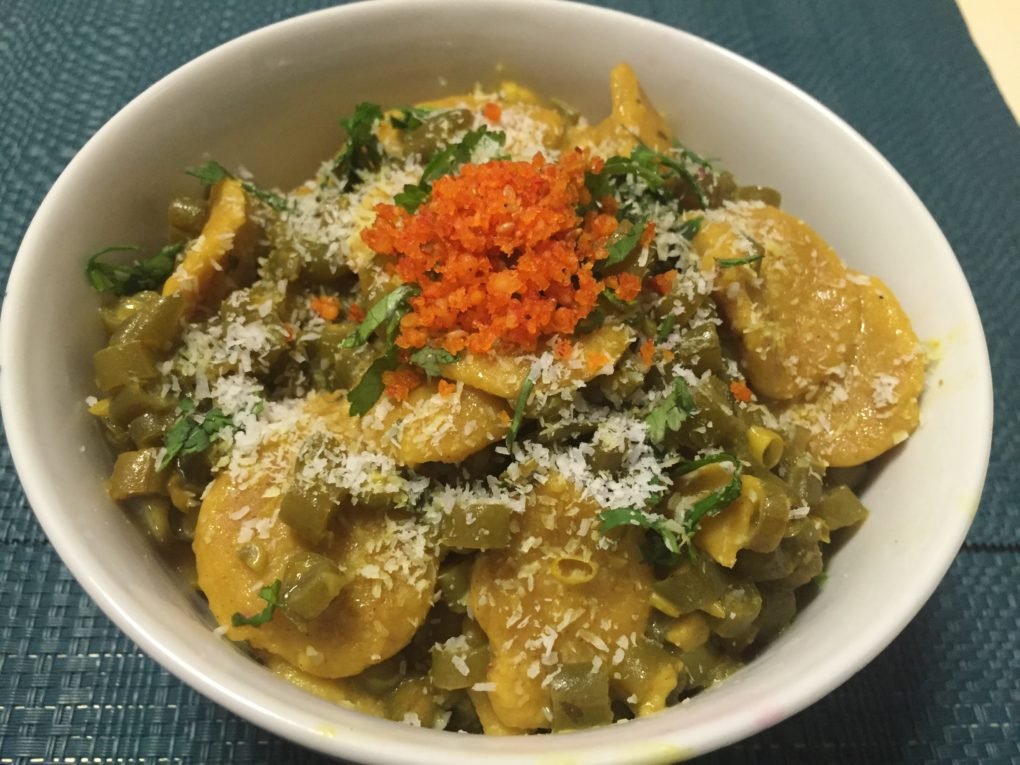
I will share the recipe of Fansi Dhokli nu Shaak with you. It is made from French beans tempered with carom seeds. Fresh ginger, garlic and chilli paste is then added to it. Then add the regular spices and let the beans cook in the boiling water. Once the water is boiling add the prepared dhoklis one by one. Then let it cook for 8-10 min or till the dhoklis and beans are cooked. So it is a kind of Indian pasta. I have prepared this in a pressure cooker. It helps in cooking it faster.
There are two steps:
- Preparing Dhokli
- Preparing the curry
While preparing dhoklis, they need to be pressed by hand. This can become a nice group activity in the house. Even your young one can help in pressing them. Generally when there is a get-together for dinner or lunch, the ladies of the house will all sit together and help in pressing the dhoklis and will also chit chat along with a cup of tea. It is a fun activity. Many Gujarati restaurants serve this dish in their menu for lunch or dinner.
I call this dhokli – Indian pasta, and give my son to eat. He relishes it happily.
Fansi Dhokli Nu Shaak (Flat Flour Dumplings In French Beans Gravy)
Ingredients
Dhokli
Fansi shaak (french beans curry)
- 1.5 cups french beans chopped
- 3 tbsp oil
- 1 tsp carom seeds
- 1 tsp ginger paste
- 1 tsp garlic paste
- 1 tsp green chili paste
- 1/4 tsp asafoetida
- 1/2 tsp turmeric powder
- 1 tsp coriander powder
- 1 tsp cumin powder
- 1 tsp red chili powder
- 1 tbsp lemon juice
- salt as per taste
- 1.5 cup water (it can be adjusted more or less as per the thickness of the gravy required)
- 2 tbsp coriander chopped
- 10 gms Dried Coconut shredded or dessicated coconut for garnishing (optional)
- 1 tbsp dry garlic chutney garnishing (optional)
Instructions
Preparing Dhokli
- In a bowl add the flours, spices, yoghurt, oil and carom seeds

- Mix them well till the crumb like texture is achieved and then add gradually water.

- Knead into a soft dough and rest for 5-10 minutes.

- Now make very small balls out of it.

- Press them and shape them into the coin size dholi. The dhoklis should be thin.

- The dhoklis are ready.

Preparing French Beans Curry
- Heat oil in the pressure pan cooker. Add the carom seed.

- Add the asafoetida and ginger-garlic-chili paste and saute till the raw smells goes .

- Add the chopped french beans. Saute and then add all the spices - red chili powder, turmeric powder, coriander cumin powder.

- Add the water and let it come to boil.

- Now add the dhokli to the boiling water one by one. Add lemon juice .Add the salt to taste. Cover the lid and pressure cook for three whishtles on high heat and two on low heat.

- The dhokli is ready . Remove it in a bowl and garnish with coriander, dessicated coconut and dry garlic chutney. Serve it hot with roti or rice .It can be eaten plain too.


Notes
- the dough should be kneaded soft. If it is hard the dholkis will become stiff.
- The dhoklis should be pressed thin.
- Spread oil on dhoklis to avoid sticking with each other.
- The water should be boiling while putting dhoklis in the curry to avoid breaking.
Nutrition
Dal Pakwan
Dal Pakwan is a very popular Sindhi breakfast. It is cooked with split bengal gram (dal) served with pakwan (crisp fried Indian bread). Sindhi cuisine is mostly popular for its taste and flavor. It has many spicy and sweet dishes. Sometimes the method of cooking is also different. Breakfast is the most important meal for them. They follow the principal of heavy breakfast , lighter lunch and very light dinner. Many restaurants will serve this dish for breakfast. Even sweet shops will have dal pakwan sold as a special dish on sundays.
The dish is delightful and can be had not only in breakfast but also in lunch, brunch or dinner.
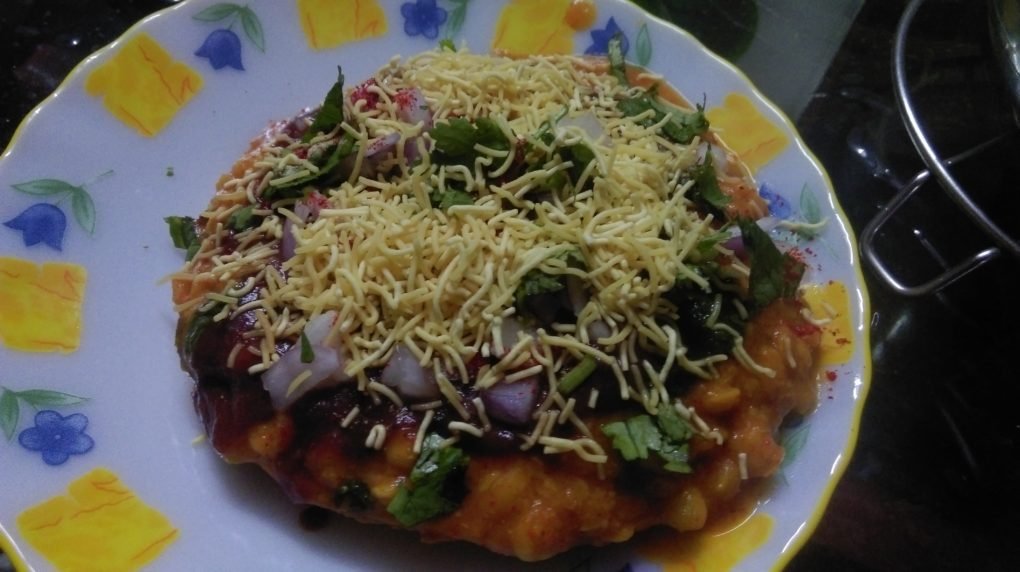
I had prepared this dish in dinner. I had this dish couple of times in the restaurants. One of my Sindhi friend had also treated me with this dish. I really enjoyed the authentic taste at her place. The dish is so simple. It is little spicy and is served with sweet chutney , green chutney and topped with chopped onions and sev.
I have shown this recipe in three steps :’
Dal recipe.
Pakwan recipe.
Assembling dal pakwan.
Traditionally pakwan is made from refined flour with little carom seeds. I have used here whole wheat flour and added other spices. These pakwans can be made ahead and kept in airtight containers. It can also be served with tea or coffee.
So dear friends make this recipe and treat your family, friends and dear ones on any occassion.
Dal Pakwan
Ingredients
Dal Recipe
- 1.5 cup bengal gram Split
- 3 cup water
- 2 green chilies split lenghtwise
- 12 curry leaves
- 2 tbsp oil or ghee if you want a more richer taste or can mix both
- 1 tsp cumin seeds
- 1/2 tsp turmeric powder
- 2 tsp red chili powder
- 1/4 tsp asafoetida
- 1 tsp dried mango powder
- 1/2 tsp garam masala
- salt as per taste
Pakwan recipe
- 2 cup whole wheat flour
- 2 tbsp semolina (sooji)
- 2 tbsp oil
- 2 tsp red chili powder
- 2 tsp turmeric powder
- 2 tsp cumin roasted powder
- 1 tsp black pepper powder
- 1 tsp carrom seeds
- salt as per taste
- water to knead a tight dough
- oil for frying
Assembling Dal Pakwan
- 1 cup Date chutney sweet chutney
- 1 cup coriander chutney
- 1 medium onion finely chopped
- 1/4 cup coriander chopped
- 1/2 cup sev
- 1 tbsp red chili powder
- 1 tbsp rock salt (sanchal)
- potatoes (optional). I have used them as my husband likes them on the pakwan.
Instructions
Dal Recipe
- Soak the split bengal or chana dal in water for 2-3 hours.

- Pressure cook dal for 3 whistle. The dal should not be overcooked and mushy. The grains should remain seperate.

- Now add the spices (red chili powder, turmeric powder, garam masala, dried mango powder, salt).Mix them. Add a little water if the dal looks dry and let it simmer.

- Now prepare the tempering. Heat oil in a pan. When it is heated add the cumin seeds and let them crackle. Add the asafoetida, curry leaves, green chilies and a tsp of red chili powder.

- Pour this tempering on the simmering dal. Just cover and cook for two minutes so that the flavor of all the ingredients is nicely infused. The dal is ready.

- Remove in a bowl.

Pakwan Recipe
- Take whole wheat flour and semolina in a bowl. Add oil, turmeric powder, red chili powder, roasted cumin seeds powder, carrom seeds and salt. Mix well.

- With the help of water, knead a tight dough and cover and keep it aside for 15 min to rest.

- Now take a lemon size ball and roll it into a nice 6-7 cms circles. Prick them with a fork. Fry them in hot oil till they are nice golden and crisp. Drain on an absorbent paper and store them in the air tight containers.

- Pakwan are ready to serve.

Assembling Dal Pakwan
- Keep all the ingredient ready on the serving table.

- Take the serving plate. Place a pakwan on it.

- Pour a big laddle of dal on it. Pour a tbsp each of coriander chutney and date chutney. The amount of chutney can be adjusted as per the individual choice. Many people even use the tamarind chutney.

- Sprinke chopped onions over it.

- Garnish it with some sev, chopped coriander and some rock salt and red chilli powder.

- The Dal pakwan is ready to serve.

Notes
Nutrition
Whole Masoor Dal (Whole Red Lentil Curry)
Masoor Dal is a very important part of vegetarian diet in Indian Cuisine.
Masoor Dal contains high level of protein. It also contains fibre, folate, vitamin B1 and minerals.It helps to lower the cholesterol and helps in managing blood sugar. It is a good source of calcium, potassium and iron.It is rich in antioxidants.
Masoor dal is cooked generally in the form of curry. It can be served with rice or roti. It can also be combined with various vegetables. It can be cooked with rice in the form of khichdi or pulav. Lentil soup is a famous recipe in international cuisine.
The dal needs very little time to cook. It is very soft and cooks quickly.
I generally try to use this dal in various ways such as dal fry, mixed pulses dosa or khichdi.
Today I will share the recipe of the curry which my mother makes and I am really fond of. She uses sambhar masala in addition to other spices and that really enhances the taste of the dal. We generally eat it with bhakri, bajri roti or parathas. Fresh sliced onions and dry garlic chutney are great accompaniment with it. You can enjoy it also with a dollop of homemade butter or simple salted butter. You won’t stop licking your fingers!
I still remember that one of my friends told me that it has the “dhaba” taste to it .
So have fun making this nutrition packed dal!!.
Whole Masoor Dal (Whole Red Lentil Curry)
Ingredients
- 1 cup masoor Whole masoor dal (soaked for two hours)
- 2 small onions chopped
- 1 medium tomato chopped
- 2 tsp ginger paste
- 2 tsp garlic paste
- 10 curry leaves
- 1 tsp mustard seeds
- 1 tsp cumin seeds
- 1/4 tsp asafoetida
- 1/2 tsp turmeric powder
- 2 tsp red chili powder
- 2 tsp sambhar masala powder
- 1 tsp coriander seed powder
- 1 tsp cumin seed powder
- 2 tbsp oil
- 1 tbsp ghee
- 2 tbsp coriander chopped
- salt as per taste
- water for cooking
Instructions
- Heat oil and ghee in the pressure cooker.

- Add the mustard seeds and cumin seeds. When they crackle add asafoetida, curry leaves and ginger garlic paste. Saute till the raw flavor of the ginger and garlic goes away.

- Add the onions and saute till translucent.

- Add the chopped tomatoes and cook till they are soft.

- Now add all the spices and salt and mix them well and saute them for a minute.

- Drain the soak dal and add to the pan. Roast it for a minute.

- Add two cups of water, stir the mixture and pressure cook for four whistle fast heat and one whistle on slow heat.

- The dal is ready. Garnish with coriander and serve.

- Serve it with the roti of your choice.